
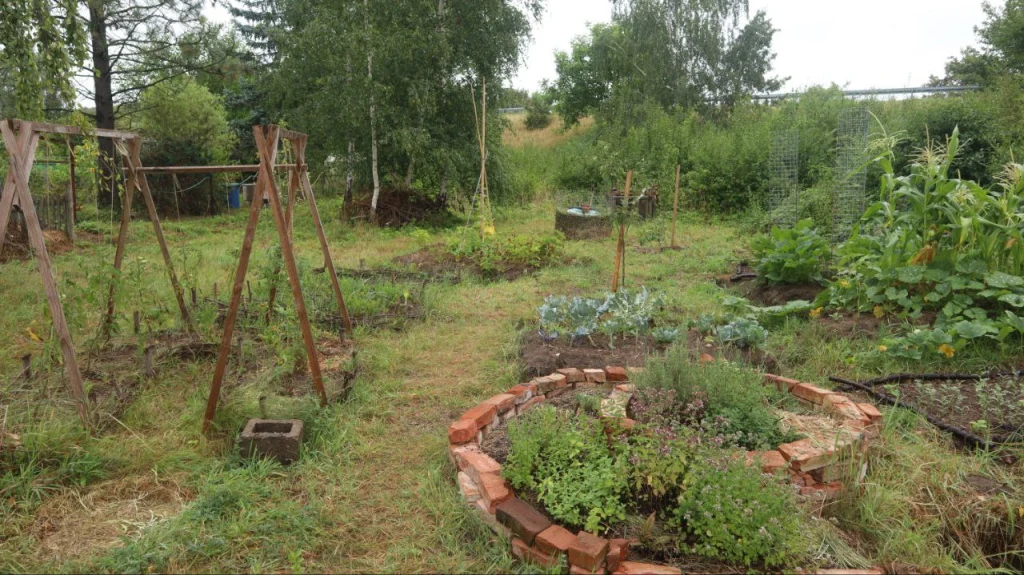
Every gardener is different and so is every garden. Everyone has their own preferences, needs and ideas. And that’s wonderful, because nature thrives on diversity.
In this article, I would like to share my gardening philosophy with you and describe my landrace gardening goals.
Perhaps this can serve as some inspiration for you, encourage collaboration or simply be a note to myself to keep a record of where my priorities lie.
My own Paradise Garden
Joe Hollis coined the term Paradise Garden to describe his mountain garden. It was to be a botanical garden full of useful plants arranged in an ornamental way. The paradise garden shoud emerge through a daily practice in a flow state and reflect the dialog between the gardener and Gaya. This allows us to return to our ecological niche and have our needs met more directly by nature [1].
For me, a paradise garden is a symbiosis with a place from which both sides can benefit. Humans are quickly labeled as harmful to planet earth, but they are capable of doing so much good for it, if only they wanted to. In my paradise garden, I want to be a benefit that initiates positive change through cultivation, design, soil building and many other processes.
I don’t want to force the land to do anything, but rather to open up possibilities and let it show me what we are capable of achieving together through techniques like chaos and landrace gardening.
Eventually, I want my garden to be a colorful mix of edible and flowering trees, shrubs, herbs and annuals where I can leave much of the work to nature.
How do I want to achieve this?
The path to my goal could probably be described relatively easily as “permaculture”, but I don’t want to make it that simple. I want to have clear procedures to guide me on how I can achieve my goals or inspire you to grow your own paradise garden.
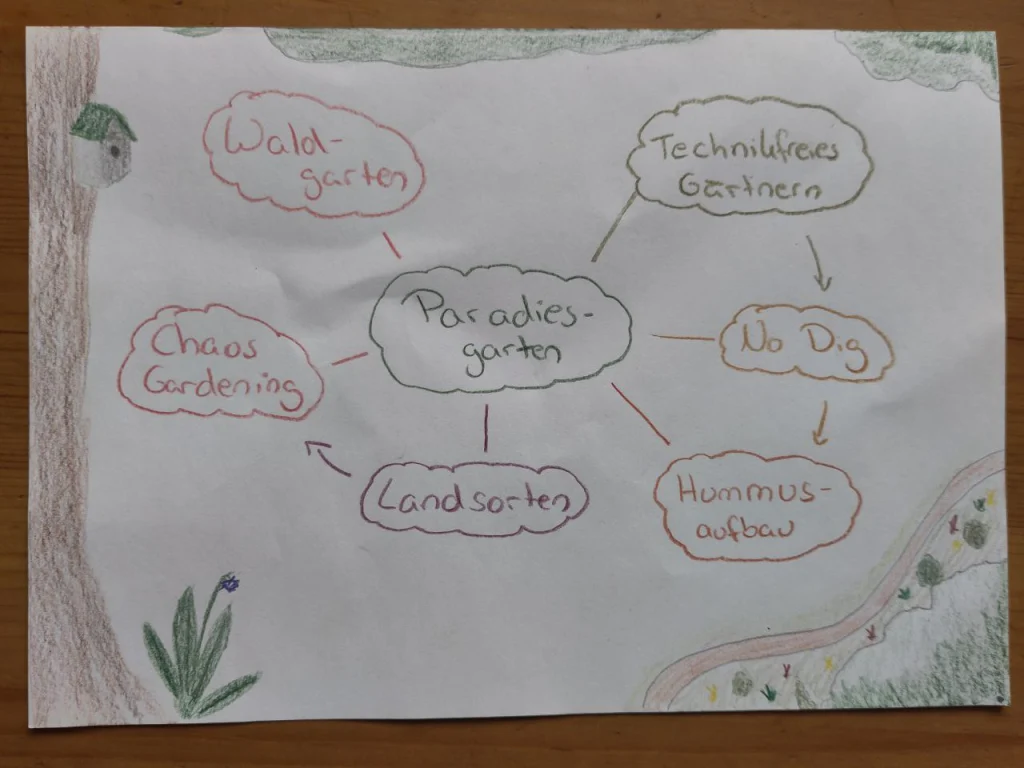
Listing all the methods would probably go beyond the scope of this article, but I would like to share a few of the most important ones with you:
Technology-free gardening
Out of sheer stubbornness or the conviction that I want to be independent of large corporations, I cultivate my garden without technology. This means that I don’t use any motorized equipment but only mechanically operated tools such as scythes, shovels, hoes and sickles. Mark Boyle’s book “The Way Home” was probably an inspiration here, in which he recorded his experiences over the course of a year without any technology.
I want the garden to be a resilient building block in my life, so I would like to learn the skills to cultivate it without the use of motorized equipment.
Book reccomendation: The Way Home von Mark Boyle
No Dig
Inspired by Charles Dowding, I want to cultivate my beds using the “no-dig” method. This means that I want to keep soil cultivation to a minimum, not only to reduce my own workload, but primarily to keep the soil structures intact and to avoid unnecessarily disturbing or injuring the soil organisms by digging.
Ideally, the beds are created simply by heaping up compost, but due to a lack of material, they can also be created by digging once. I want to use what I have, and if something is missing you have to get creative in other ways. A few beds have already been created using the “lazy bed” method and will hereafter not be dug over again. Depending on the soil conditions, I was also able to loosely chop and remove the grass cover quite easily to create space for my vegetable plants. This has helped to maintain the soil horizons a little better.
Annual mulching with compost should continue to feed the soil and provide the best conditions for my plants.
Building Organic Soil Matter
This is probably where I see the most potential for humans to make themselves useful: increasing the organic matter in the soil. This not only increases the water storage capacity, increases the amount of microorganisms living in the soil, but can also bind an incredible amount of CO2 long term. Biochar is a stable form of carbon and can fixate it for centuries. The production process is not as complicated as you might think at first and can transform unwanted plant matter, in our case the pesky blackberry bushes that wanted to take over the garden, into a wonderful, valuable material. Together with compost, mulch and chop and drop, soil can be improved, benefiting not only the plants but all living creatures.
Planting the beds all year round not only protects them from being washed out, but also makes ideal use of the area and creates additional biomass. Plants hold the soil together with their roots and store water, preventing the loss of valuable topsoil and resources. Shading the surface slows down the evaporation of the stored water and at the same time protects the soil from heavy rain. Edible greens, some growing even in winter, not only provides food but also protects and improves the soil.
A dry toilet will also be moving into the garden in the near future. This way we can not only meet our needs, but also save water and use the resources efficiently instead of flushing them down the drain with valuable drinking water. These can be composted separately and then used to fertilize the fruit trees, for example, or other things without direct contact with the soil. If you take a closer look at the topic (see book recommendation), it’s amazing that we still have our conventional flush toilets at all.
Especially in the face of the climate catastrophe, these methods are so valuable. The amount of carbon that can be stored in a small garden cannot change the whole world, but as we all know, little steps can add up and the more gardeners who implement this method, the greater our collective impact. But these methods can also make your garden more climate resilient, as healthy soil not only supports the plants, even in times of stress, but also stores significantly more water and the garden is better protected against extreme weather conditions.
Book recommendation: Die Hummusrevolution von Ute Scheub und Stefan Schwarzer
Book recommendation: The Humanure Handbook von Joseph Jenkins
Landrace Gardening
Climate resilience can also be promoted through the use of locally adapted plant varieties. However, very few of the commercially available varieties and seeds will be adapted to your garden, as they grow under strongly controlled environments and each location and its conditions are unique. To find the right varieties for your location, you can either try out various varieties or simply breed your own, so-called landraces. This involves crossing many different varieties, letting them be culled through natural selection and your own preferences, and obtaining their seeds, which are then grown again the following year. Over the years, this results in your own varieties that are increasingly better adapted to you and your location.
The breeding goal of my landraces varies slightly from species to species and I will share these with you in more detail in the relevant posts. In general, however, I want to grow healthy, site-adapted plants that produce a good harvest in terms of taste and quantity. I don’t want to have to look after the plants too much, ideally I just want to put a few seeds in the ground, check on them from time to time, carefully guide them in the right direction and, last but not least, of course, harvest them. Harvesting my own seeds also makes chaos gardening easier, as I have plenty of seeds available with little extra effort, which can then be used more generously when sowing.
Chaos Gardening
Chaos gardening is a type of gardening that leaves a lot of freedom. My interpretation goes in the direction of throwing seeds into the beds and seeing what grows where.
As I would like to sow the seeds mainly by direct sowing, so that the plants can choose their ideal germination time themselves and are spared having to be transplanted, chaos gardening fits in quite well with this goal. By sowing abundantly in different places, a surplus of plants can be created and a less ideally chosen location does not alone determine whether the crop will be successful this year.
Forest Garden
Without the intervention of humans or large herbivores (which do not exist in my garden), terrestrial ecosystems in our latitudes gradually transform into a forest. And I want my garden to head in this direction as well. But not just any forest, no, a forest garden. Instead of the beech, oak, birch, ferns, shrubs and grasses we are familiar with, I want to create a forest with a rich structure consisting of nut and fruit trees, raspberry bushes, herbs, annual and perennial vegetable plants and, of course, flowers. A colorful mixture in which I can go foraging and enjoy my paradise garden to the full.
That’s enough from my garden for now.
Until next time,

Citation
[1] Paradise Gardening (an essay by Joe Hollis) — Mountain Gardens (mountaingardensherbs.com)